Reviews
Part of IRS Mileage Rates and Logs: Methods, Business Miles and the First Year Choice
Nine mileage rates mistakes that cost you a deduction
The nine mileage rates mistakes that cost vehicle deductions, from counting the commute to guessing a business-use share, and what each one needs to survive.
Vehicle claims fail for boring reasons. Almost none of them involve a difficult rule. They involve a record that was never made, a category that was never checked, or a number that was estimated once and then repeated for four years.
Here are nine mileage rates mistakes, starting with the two that do the most damage.
What to take away
- Most vehicle deductions are lost to missing records, not to disallowed rules.
- The commute is the single most expensive misunderstanding in this subject.
- A percentage you cannot derive from anything is not a record, however reasonable it sounds.
- The IRS sets the business rate each year; for 2025 it is 70 cents a mile. A CPA or enrolled agent decides which method your vehicle may use.
The nine
1. No contemporaneous log
The deduction dies here more often than anywhere else. Nothing you write in filing season carries the weight of something written the week it happened, and no amount of confidence replaces it.
2. Counting the commute
Home to a regular workplace is personal driving, and Publication 463 says so in as many words: getting to and from a regular job is a personal expense, not a business one. Distance does not change that, and neither does answering email on the way. Whole claims have been built on the belief that a long drive must be a business one.
3. Claiming the rate and the running costs
A standard per-mile figure is designed to stand in for a list of vehicle costs. Adding fuel and repairs on top of it claims the same money twice. Which costs sit inside the bundle and which sit outside is set out for each year, and it is not a matter of opinion.
4. Guessing the business-use share
"Roughly seventy percent" is a feeling. A share that comes out of business miles divided by total miles is a calculation. Only one of them survives a question.
5. No odometer readings
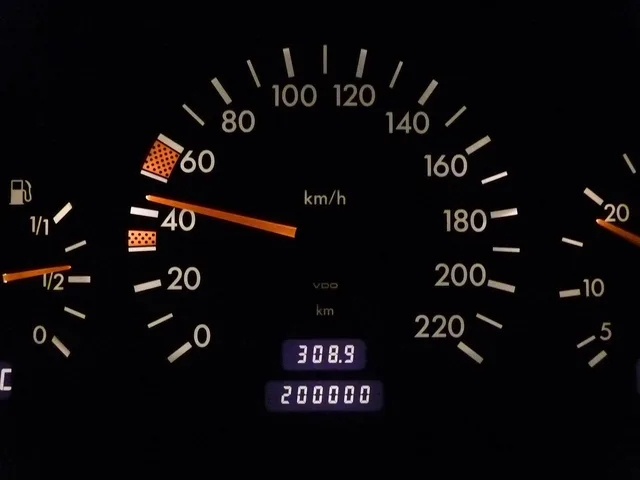
Without total miles for the year, the business share has no denominator. This matters most under the actual expense method, where the share is the entire calculation.
6. Recording where but not why
A log of addresses proves you drove somewhere. The purpose field is the one an examiner reads first, and it is the one people skip because it feels obvious at the time.
7. Switching methods without checking
The method a vehicle started on can restrict what it is allowed to do later. If you own the car, the standard mileage rate has to be chosen in the first year the car is used for business; start with actual expenses instead and the standard rate is generally closed off for that vehicle. Changing because this year's arithmetic looks better, without confirming that the change is permitted, is the kind of error that reaches back across several returns at once.
8. Treating a home office as settled
Whether trips from home count as business miles can turn on whether the home qualifies as the principal place of business. That is a specific test, not a description of where you happen to sit. The IRS sets it out in Publication 587, and it is worth reading before you rely on it.
9. Assuming an employee is in the same position
The treatment of unreimbursed vehicle costs for employees is not the same question as the treatment of a business's own vehicle costs. The 2017 tax law suspended unreimbursed employee business expenses, including the vehicle costs employees once reported on Form 2106, as a miscellaneous itemized deduction for tax years 2018 through 2025. A self-employed driver claims the same miles on Schedule C instead. If you are an employee, ask whether your employer can reimburse you under an accountable plan, and check the current position rather than an old habit.
What the nine have in common
| Mistake | Missing record | Wrong category | Untested assumption |
|---|---|---|---|
| 1, 5, 6 | Yes | ||
| 2, 3 | Yes | ||
| 4 | Yes | Yes | |
| 7, 8, 9 | Yes |
Three of them are a paperwork habit. Two are a definition anyone can learn in ten minutes. One — guessing the business-use share — is both a missing record and an untested assumption. The last three are questions people answered in their own heads and never put to someone qualified to answer them.
Mileage mistake types
Missing record
- Mistakes 1, 5, 6
- Yes
- Mistakes 2, 3
- Mistake 4
- Yes
- Mistakes 7, 8, 9
Wrong category
- Mistakes 1, 5, 6
- Mistakes 2, 3
- Yes
- Mistake 4
- Mistakes 7, 8, 9
Untested assumption
- Mistakes 1, 5, 6
- Mistakes 2, 3
- Mistake 4
- Yes
- Mistakes 7, 8, 9
- Yes
That is the pattern worth taking away: the expensive errors are not clever. They are the ones nobody checked because they did not feel like questions.
Where the answers live
Question / Where it is answered
- What the per-mile figure is for your year, and what it covers
- The IRS standard mileage rates page, for the correct year
- What records a vehicle claim needs
- IRS Publication 463
- Whether your home qualifies as a principal place of business
- IRS Publication 587, then a professional
- Whether this vehicle may switch methods
- Your prior returns, read by a CPA or enrolled agent
The record requirements themselves are written down rather than left to preparer taste. Publication 463 is where they sit, along with the restrictions attached to each method for the year it covers.
The mileage rates overview covers the two methods and what a defensible log contains.
The wider question of what makes any claim supportable is in tax records and audits. If an entity, not you, owns the vehicle, entity tax treatment is the groundwork. Our payroll tax guide explains why a careless reimbursement can be taxed as pay.
Common questions
I have no log for last year. Is the deduction gone?
Not necessarily, but it is weaker. Reconstruct what other records genuinely support, such as calendars, invoices and job sheets, mark clearly which entries are reconstructed, and tell your preparer. Then start logging from today, because this year is still fixable.
Is it safer to claim nothing?
No. Under-claiming is a cost with no benefit. The answer to uncertainty is a record, not a smaller number.
My accountant never asked for a log. Should I worry?
Ask them what they would produce if the claim were questioned. A preparer works from what you hand over, and a missing log leaves no trace in the figures they see.
Which of the nine is the most expensive?
Number 2, by volume, because it can invalidate a large share of the miles claimed. Number 1 is the most common and the hardest to repair.