
Guides
Self-Employed Deduction Order: Mileage, SEP-IRA and Quarterly Tax
Self-employed deduction order: standard mileage, SEP-IRA contributions and quarterly tax decide how a lean year and a strong year are funded.
What to take away
- Mileage records, a cash buffer and the quarterly estimate come before any retirement contribution.
- A lean year favors the standard mileage rate and money you can reach; a strong year favors deductions taken at the top marginal rate.
- A SEP-IRA accepts roughly 20 percent of net self-employment income; S-corp distributions to an owner add no room.
- The estimated tax safe harbor is 90 percent of this year's liability or 100 percent of last year's.
- No deduction repairs a business that does not collect what it bills.
Why the year sets the order
Every dollar a sole proprietor earns goes to one of four places: recorded mileage, equipment, a retirement contribution, or the IRS. The calendar decides which comes first, not preference.
A $10,000 deduction is worth more in a $150,000 year than in a $60,000 year. Those figures are illustrative. The bracket a year lands in sets the value of everything claimed inside it.
Married owners should map both incomes before choosing anything. Two schedules feeding one joint return push income across bracket edges, which is the case made in Married Filing Jointly as a Sole Proprietor: Mileage, Section 179, Quarterly Tax.
The four figures that set the order
| Figure | What it fixes | Authority |
|---|---|---|
| Standard mileage rate | Cost per business mile in place of actual costs | IRS annual notice, Publication 463 |
| Section 179 vehicle | First-year expensing for a heavy vehicle | IRS Publication 946, $32,000 SUV cap for 2026 |
| SEP-IRA contribution | A deduction near 20 percent of net self-employment income | IRS annual limit |
| Quarterly estimate | The underpayment penalty | Form 1040-ES, Publication 505 |
Mileage is the figure you control daily. Each logged business mile becomes a deduction at the published rate, and Publication 463 sets out when the standard rate can be used and when actual expenses must take over. The IRS's standard mileage rates for self-employed and business use are 70 cents a mile for 2025, 72.5 cents for January 1 to June 30, 2026, and 76 cents for July 1 to December 31, 2026, so a 2026 log has to show which half of the year each trip fell in.
The Section 179 rules reward weight. Publication 946 explains the cap for a heavy SUV over 6,000 pounds GVWR, which is where the large first-year write-off sits.
The SEP-IRA has a ceiling as well as a percentage. Under the IRS's SEP contribution limits, contributions cannot exceed the lesser of 25% of compensation or $72,000 for 2026. A quarterly estimate is a payment, not a deduction, and it is the one most often skipped. Publication 505 gives the safe harbor: pay 90 percent of this year's tax or 100 percent of last year's, and no penalty applies. For a strong year after a strong year there is a catch in the 2026 edition of Publication 505: if your AGI for 2025 was more than $150,000 ($75,000 if married filing separately), substitute 110% for 100%.
If most of your income arrives on Form 1099-NEC with nothing withheld, how US creators file taxes with 1099 income and quarterly payments sets out the same four dates.
The sequence to follow
- Log business miles the week they happen, with a start and end odometer reading.
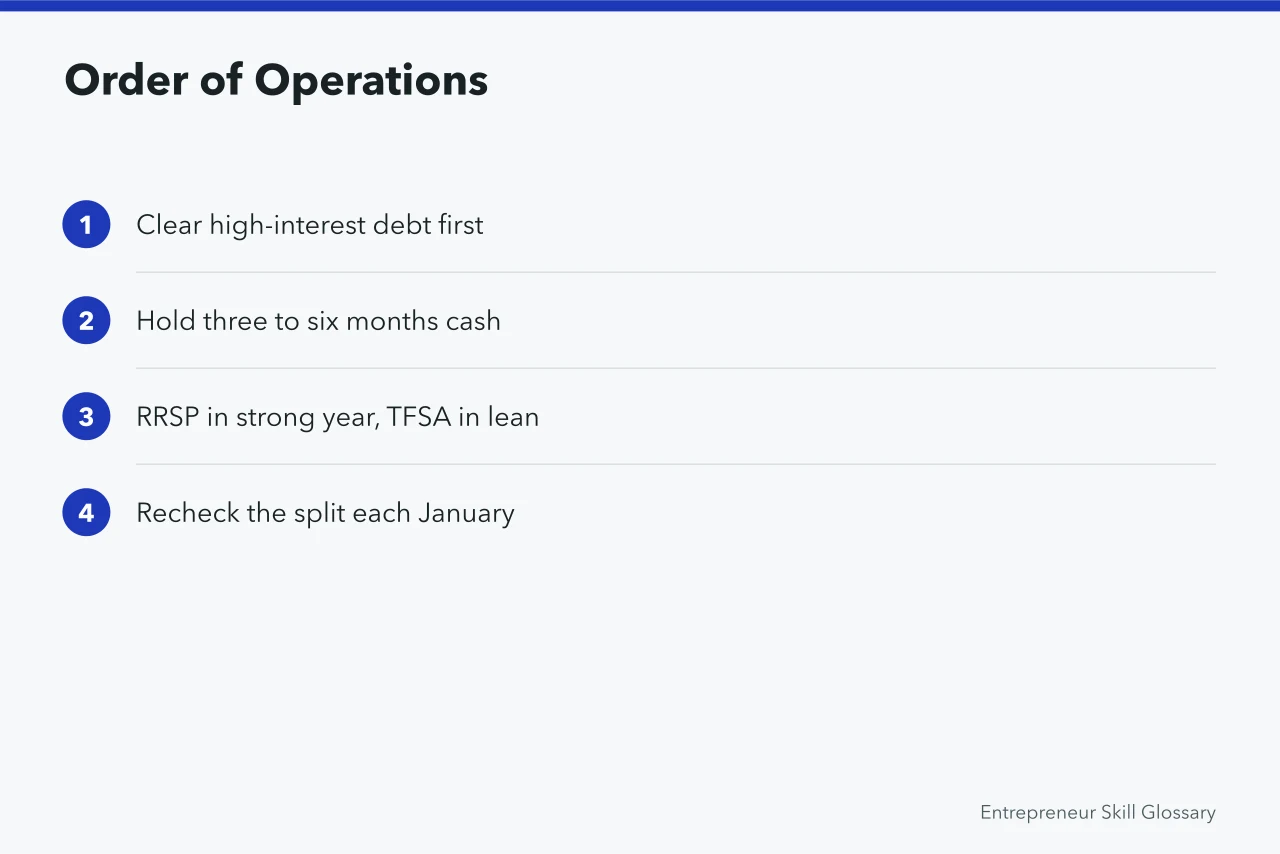
- Hold a buffer of three to six months of expenses before funding any retirement account.
- Send the quarterly estimate by April 15, June 15, September 15 and January 15.
- Match the deduction to the yearmileage and reachable cash when income is thin, a deductible contribution when it is not.
The order matters more than the label on any account. A Solo 401(k) and a SEP-IRA both shelter money, and neither creates it.
A mileage log that will not survive an exam is worth nothing, and six checks before signing off on tax records covers the substantiation an examiner actually asks for.
A buffer is not a deduction, but it is what keeps a slow quarter from forcing a distribution or a card advance.
Example: one contractor, two years
A Denver sole proprietor nets about $70,000 in one year and about $160,000 in the next. Those figures are illustrative.
In the lean year the standard mileage rate and a cash buffer come first, and retirement money goes where the withdrawal will not be taxed later. In the strong year a $25,000 SEP-IRA contribution at a 24 percent marginal rate saves roughly $6,000 in federal tax. That saving is illustrative as well.
The account choice is the second decision. Pricing, collections and cash flow come first.
An extension moves the filing date and not the payment date, which is the first of the deadline mistakes that start with treating an extension as more time to pay.
A separate 14,000 business miles, logged properly, produces a deduction computed at the IRS rate for the tax year.