
Rules
How Marriage Changes Your IRS Filing Status as a Sole Proprietor
Your IRS filing status after marriage turns on December 31 and changes your standard deduction, Section 179 limit, payroll and estimates.
What to take away
- Filing status covers a whole tax year and turns on whether you were married on December 31, so a late December wedding changes that year's return.
- For 2025, Publication 501 lists a $30,000 standard deduction for married filing jointly and $15,000 for a single filer.
- Marriage leaves the standard mileage rate alone but moves your bracket and your Section 179 limits.
- A spouse on the payroll creates a deductible wage and moves income into a lower bracket.
The December 31 test decides the whole tax year
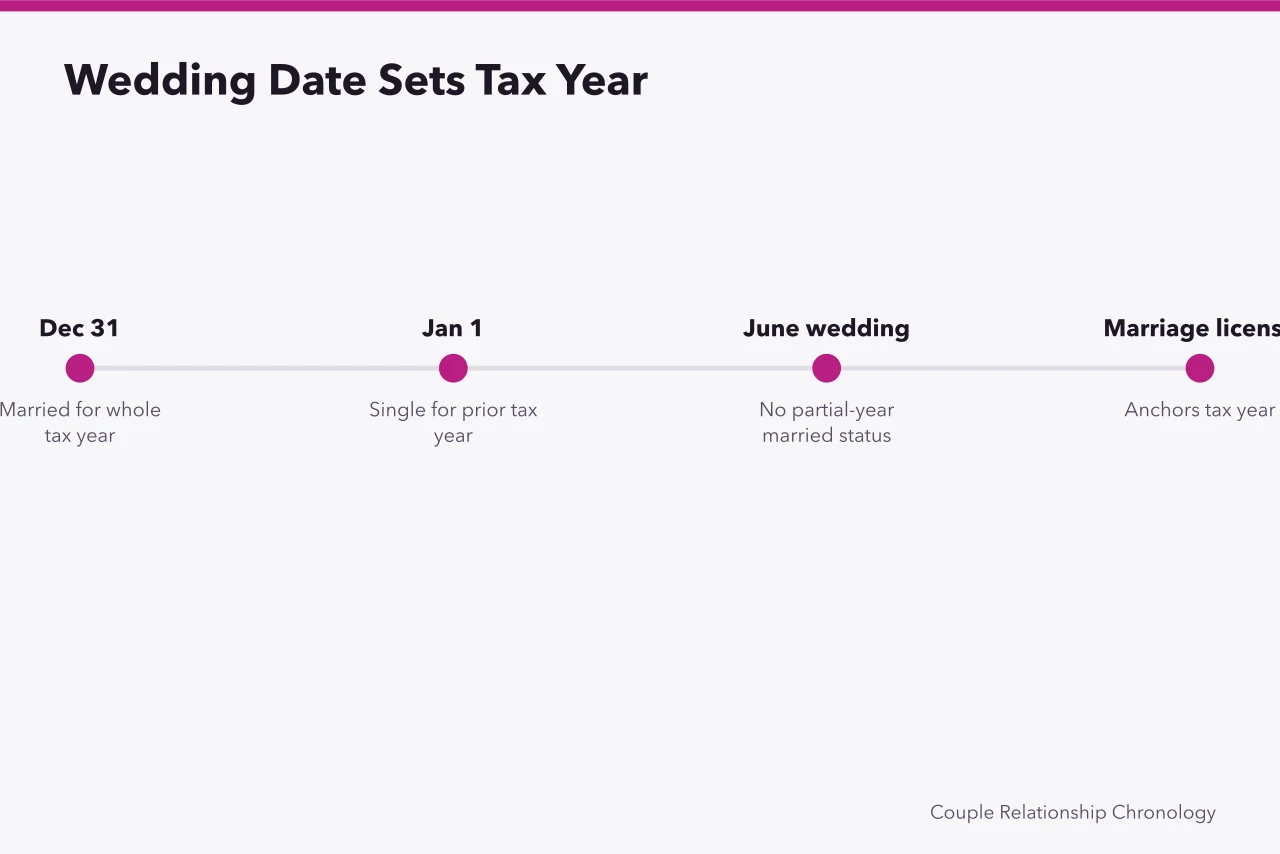
Your wedding date sets which tax year your status changes. A couple married on December 31 is treated as married for the whole year under federal rules. No partial-year status exists.
A ceremony on New Year's Eve counts for that year. One on January 1 counts for the next.
The test is federal, so every state applies it the same way. Most tax deadline mistakes begin with treating a fixed date as flexible.
Status drives the standard deduction, the bracket and several business limits at once.
What married filing jointly changes on a Schedule C return
Filing jointly puts both incomes on one return and changes how the qualified business income deduction applies to your Schedule C profit. The standard deduction figures below come from Publication 501.
Filing status changes
Standard deduction (2025)
- Single
- $15,000
- Married filing jointly
- $30,000
- Married filing separately
- $15,000
Who qualifies
- Single
- Unmarried on December 31
- Married filing jointly
- Married on December 31, both spouses agree
- Married filing separately
- Married but filing apart
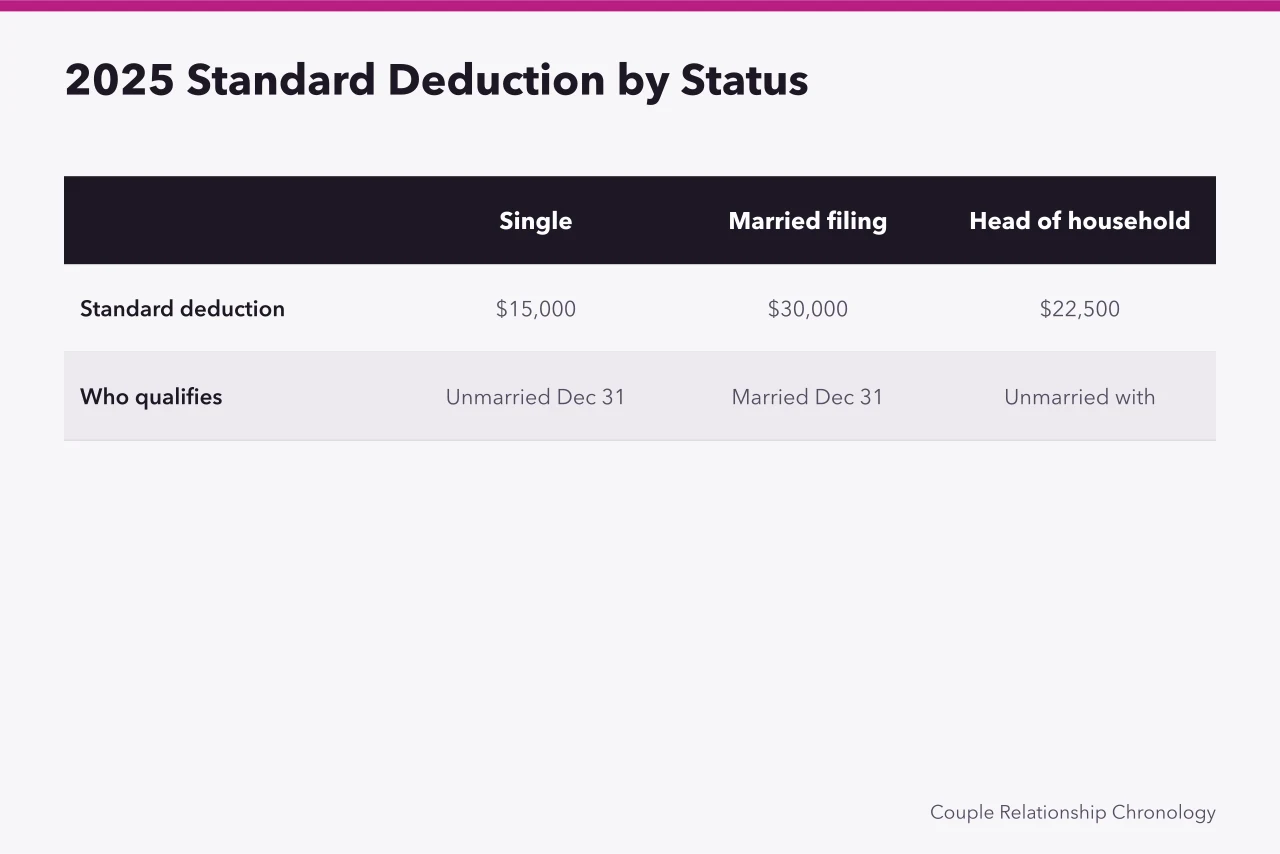
Bracket widths matter more than the deduction for two earners. Joint brackets run wider than the single ones, and the qualified business income deduction phases out at a higher income level for a joint return than for a single filer.
That gap is the marriage penalty, and it is worth checking rather than assuming. Run both versions before you file, and keep the records that support your deductions for whichever return you choose.
Section 179 and the mileage method when your status changes
The standard mileage rate does not move with your filing status, whether one owner drives or two. The method you choose does, and IRS Publication 463 covers when each method is allowed.
For a heavy vehicle, the Section 179 eligibility rules decide what the business can claim, and Publication 946 covers which vehicles qualify, including the 6,000-pound threshold for SUVs. The Section 179 limit applies once to a married couple filing a joint return, not once for each spouse, so two sole proprietors who marry work with one limit, not two.
Keep records for both spouses:
Section 179 records
- A mileage log with date, destination and business purpose for each trip
- Bill of sale or lease for each business vehicle
- Payroll records for a spouse on the payroll
Employing your spouse and the W-4 after a wedding
A sole proprietor can put a spouse on the payroll when the work is real and the pay reasonable. The wages are a business deduction, and payroll taxes apply as for any hire.
Your own net profit still carries self-employment tax, reported on Schedule SE, and a spouse's W-2 wages are not netted against it. Each of you pays on your own earnings.
If the withholding math is more than you want to run by hand, software, bureaus or a CPA each handle a small payroll differently.
Update withholding in this order:
W-4 after a wedding
- Have your spouse file a new Form W-4 for any outside job, using the two-earner worksheet.
- File your own W-4 with your employer, so neither income is withheld at the single rate.
- Change the name with the Social Security Administration before the next payroll run.
Withholding is not retroactive to January, so earlier is better.
Estimated taxes after the status change
A sole proprietor pays through quarterly estimates on Form 1040-ES. Marriage changes the amount you pay, not the quarterly schedule.
The safe harbor sits in IRS Publication 505: pay 90% of this year's tax or 100% of last year's. The figure rises to 110% when prior-year AGI is over $150,000.
Set the amount from projected profit, not last year's balance. Moving from a paycheck to 1099 work runs on the same quarterly schedule, and handling 1099 income and quarterly payments covers the first year.
Amending a return filed under the wrong status
Form 1040-X corrects a return filed under the wrong status. The window is generally three years from the original filing date or two years from the payment date, whichever is later.
You can move between joint and separate filing. You cannot move to single once you were married on December 31.
An example: two businesses and one joint return
Two spouses each show $100,000 of net profit from separate sole proprietorships. Filed separately, each income stack climbs the single brackets, which run about half as wide as the joint ones at that level. Filed jointly, the same total sits in wider brackets.
The comparison only works if the numbers hold up.
Separate filing shuts out the earned income tax credit, the child and dependent care credit and education credits, and it caps Roth IRA contributions at a much lower income level than a joint return. It rarely wins for two similar earners, and the records behind your deductions are what support whichever return you choose.