Guides
1099 tax basics for American creators earning image licensing income
Creator rights and image consent online meets US tax reality: how 1099-NEC and 1099-K forms, self-employment tax and state sales tax apply to licensing income.
What to take away
- License fees and stock royalties are self-employment income. They belong on Schedule C, with or without a form.
- Commissioned work arrives on Form 1099-NEC. Library royalties arrive on Form 1099-MISC. Marketplace payouts arrive on Form 1099-K.
- The Form 1099-K threshold is $2,500 for tax year 2025, the return you file in 2026, and $600 from tax year 2026 under the current phase-in.
- Self-employment tax is 15.3% of net profit12.4% for Social Security and 2.9% for Medicare. Half of it is deductible.
- Quarterly estimates fall due April 15, June 15, September 15 and January 15. Sales tax on digital image licenses is a separate, state-by-state question.
Match the payment to the form
Which form you receive depends on what the payer believed it was buying.
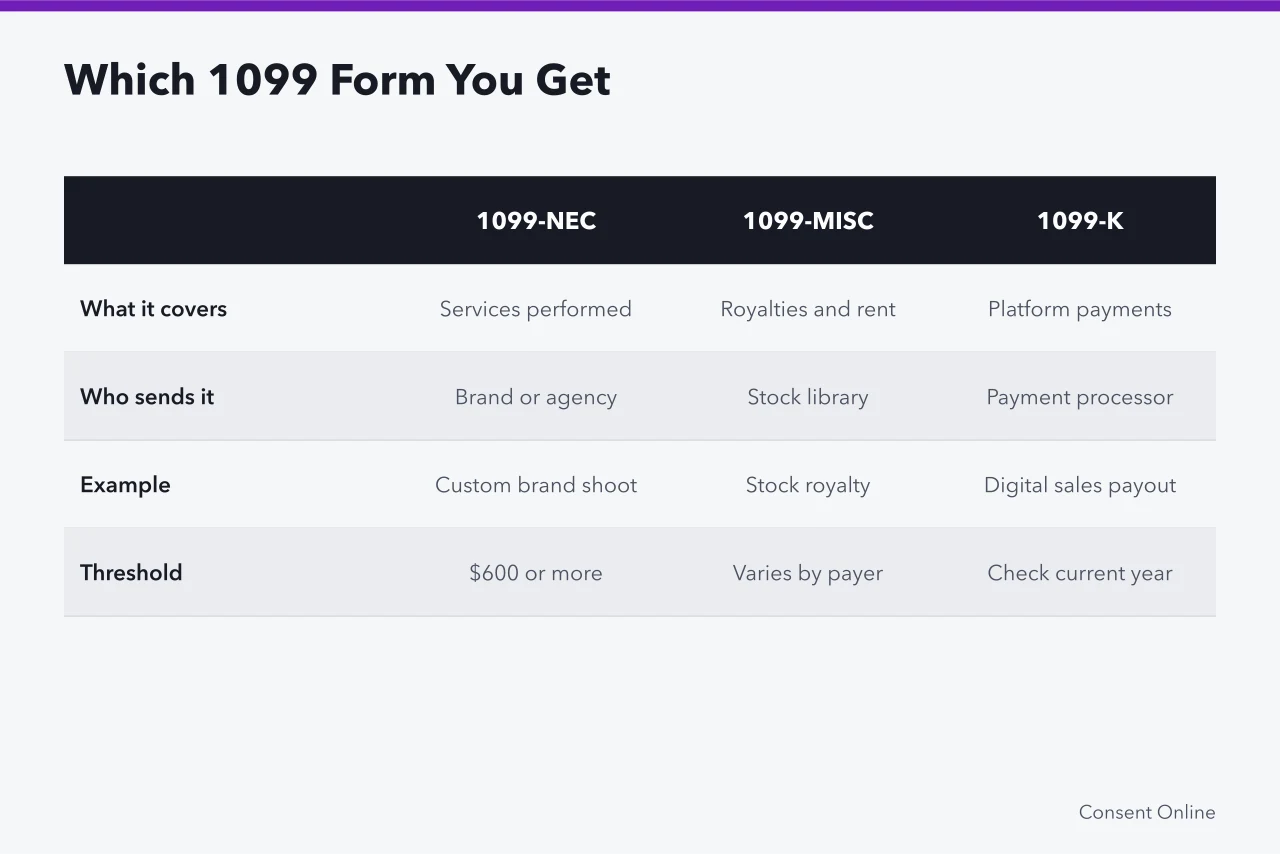
A brand commissioning a shoot is buying a service. Payments of $600 or more go on Form 1099-NEC, which reports nonemployee compensation. The IRS page about Form 1099-NEC lists the filing triggers and deadlines.
A stock library paying you per download is paying a royalty. That usually lands on Form 1099-MISC. A marketplace handling card payments reports gross volume on Form 1099-K.
| What you did | Form you should receive | Who sends it |
|---|---|---|
| Commissioned shoot for a brand | 1099-NEC | The brand or its agency |
| Royalty from a stock library | 1099-MISC | The library |
| Storefront and card payouts | 1099-K | The payment processor |
| One direct license under $600 | None required | Nobody; you self-report it |
If the money flows through a partnership, an agency entity or an inherited copyright, the paperwork changes shape. A Schedule K-1 guide explains why the income shown on that form can differ from the cash you received.
Form 1099-K thresholds for tax year 2025 and 2026
The threshold has moved four times in four years. The old rule was $20,000 across 200 transactions.
Congress cut the figure to $600, then the IRS phased it in. It was $5,000 for tax year 2024 and $2,500 for tax year 2025. The $600 figure applies from tax year 2026 unless Congress changes it again.
A 1099-K reports gross payment volume, not profit. A $30,000 figure can represent $9,000 of taxable profit once platform fees, refunds and expenses come out. Report the gross, then subtract what it cost you to earn it.
Personal payments sometimes appear on the form. Keep the record that shows which deposits were business and which were a friend settling a dinner bill.
Self-employment tax and the quarterly dates
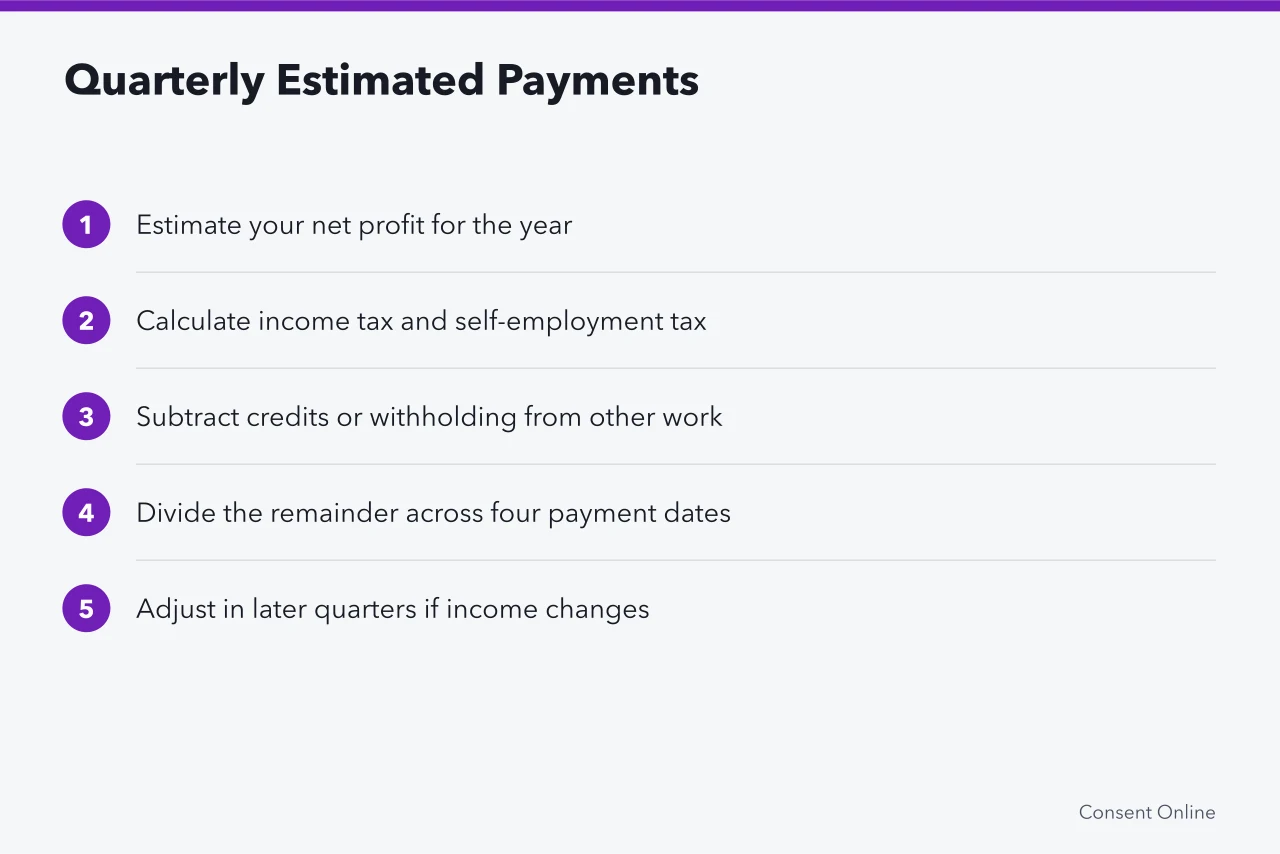
Self-employment tax covers the Social Security and Medicare an employer would normally split with you. The rate is 15.3% of net profit, split into 12.4% for Social Security and 2.9% for Medicare.
The Social Security portion stops at the annual wage base, which was $176,100 for 2025. Medicare has no cap. The tax applies to 92.35% of net profit, and you deduct half of the result from gross income.
Safe harbor rules keep the underpayment penalty away. Pay 90% of this year's tax or 100% of last year's. The prior-year figure rises to 110% once your adjusted gross income passes $150,000. Form 1040-ES carries the worksheets.
Quarterly dates
- April 15, 2026, covering income earned through March.
- June 15, 2026.
- September 15, 2026.
- January 15, 2027, for the closing quarter of 2026.
If consulting or analytics work sits beside your licensing income, the IRS tax checklist for contract work walks the same ground from 1099s through quarterly payments.
Example: $48,000 of licensing income
Gross licensing and commission income: $48,000. Platform and agency fees: $4,000. Camera and lighting: $3,200. Software and storage: $1,800. Studio share of the home: $1,500. Business driving: 2,400 miles.
At 70 cents a mile, the 2025 business rate, the mileage claim is $1,680. Total deductions reach $12,180, leaving $35,820 of net profit. The 2026 rate is published each December, so substitute the current figure.
Self-employment tax is 15.3% of 92.35% of that profit: roughly $5,060. Half, about $2,530, comes off gross income.
The mileage claim alone saves about $240 in self-employment tax and about $370 in income tax at a 22% marginal rate. That is roughly $600 returned for keeping a logbook. Compare methods in standard mileage versus actual expenses before you choose one for the year.
Deductions that cut both taxes
Every business expense reduces income tax and the self-employment tax base. Common claims, with typical annual amounts:
- Camera bodies, lenses and lighting used for client worktypically $1,000 to $5,000.
- Editing software, cloud storage and reference subscriptionsoften $200 to $900.
- Home studio under the simplified method: $5 per square foot up to 300 square feet, so up to $1,500.
- Business mileage at the published rate, logged by date and destination.
- Props, backdrops, model releases and location feeswhatever you paid, receipts attached.
A phone or a car used for two purposes is deductible only in the business proportion. Track it. A clean percentage with no support looks invented.
IRS Publication 535 sets the ordinary and necessary test and the record keeping standard behind each line above.
Gear stored in a dedicated room raises a separate question about qualifying space, and home office storage rules under IRS guidance lay out where the line falls.
State sales tax on digital image licenses
Nexus decides where you must register. Physical presence still counts. So does economic nexus, often set near $100,000 in sales or 200 transactions in a state.
Examples
- No statewide sales tax
- Alaska, Delaware, Montana, New Hampshire, Oregon
- Digital goods generally taxable
- Texas, South Dakota, Washington, Pennsylvania
- Electronically delivered images generally not taxed
- California
What it means for image licenses
- No statewide sales tax
- Nothing to collect at state level; Alaska has local taxes
- Digital goods generally taxable
- Registration and collection can apply once nexus is crossed
- Electronically delivered images generally not taxed
- Software and custom work follow different rules
Marketplace facilitator laws usually push collection onto the platform when you sell through one. Direct storefront sales sit with you. Definitions of a specified digital product vary, so read the state statute for the year you are filing.