Guides
R&D Credit and Mileage: Federal Rules for Boston and Chicago Firms
Business tax deductions and mileage beside the R&D credit: the federal Section 41 claim on Form 6765, the payroll election, state rates, and the records.
What to take away
- The federal R&D credit cuts tax owed dollar for dollar. It is not a deduction.
- Mileage for research travel, field testing and client visits is a separate deduction. The 2025 IRS business rate is 70 cents a mile.
- Marketing, brand work and pricing studies fail the qualified research test in Massachusetts and Illinois.
- Payroll records, project narratives and time tracking decide whether a claim survives review.
- A credit on this year's research usually reaches the bank 12 to 18 months later. Plan cash around that gap.
How the credit sits beside your deductions
A deduction lowers taxable income. The R&D credit cuts the tax itself. Owners who treat the two as one lever end up with a plan that does not hold.
Qualified research expenses are mostly wages for the people doing the work. Supplies and contract research make up the rest. A formula tied to prior-year research spending sets the credit.
Loss-making companies can often apply the credit against payroll tax instead of income tax. The federal credit is the credit for increasing research activities under Internal Revenue Code Section 41. Its regular credit is 20 percent of the excess of qualified research expenses for the year over a base amount. A taxpayer can instead elect the alternative simplified credit, 14 percent of the qualified research expenses that exceed 50 percent of the average for the 3 preceding taxable years. A qualified small business is a corporation or partnership with gross receipts of less than $5,000,000 for the tax year and no gross receipts for any year before the 5-taxable-year period ending with that year. It can elect to use part of the credit against payroll tax: up to $250,000, a limit increased by another $250,000 for taxable years beginning after December 31, 2022.
Form 6765 is the form used to figure and claim the credit, to elect the alternative simplified credit, and to make the payroll tax credit election; partnerships and S corporations must file it to claim the credit. A qualified small business that claims the payroll tax credit then completes Form 8974 and attaches it to the employment tax return.
Contract research is a weak spot. Payments of $600 or more to an individual for research work generally call for a Form 1099-NEC, and the filing rules for Form 1099-NEC sit on the IRS site.
A consultant paid that way meets the same calendar from the other side. Filing taxes with 1099 income and quarterly payments covers how those estimates are timed.
What counts as qualified research
Qualified research has to be technological in nature, rest on engineering or computer science, and aim at resolving uncertainty about capability or method. The tax code sets that test in Section 41(d): the research must be undertaken to discover information that is technological in nature, that information must be intended to be useful in developing a new or improved business component, and substantially all of the activities must be elements of a process of experimentation.
Campaigns do not qualify. Market research, customer surveys, brand work, pricing studies and routine product improvement do not either.
Custom software can qualify when the technical uncertainty is real. A bespoke attribution model or a data pipeline may count.
The line between the two is what a reviewer tests first.
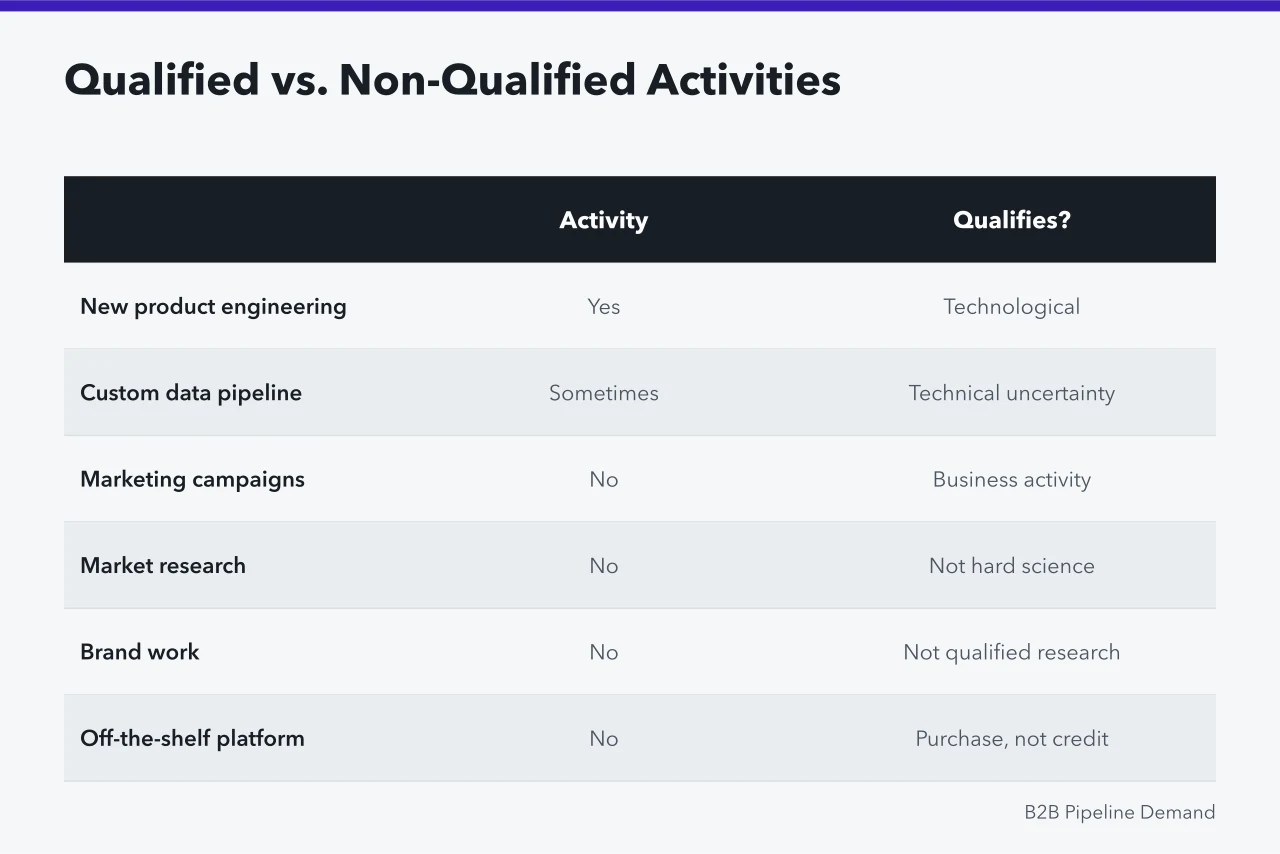
| Activity | Typically qualifies | Why |
|---|---|---|
| New product engineering | Yes | Technological uncertainty, hard science |
| Custom attribution pipeline | Sometimes | Turns on technical uncertainty and use |
| Paid search and display | No | Marketing activity, no technical uncertainty |
| Customer and market surveys | No | Excluded business research |
| Production line process change | Sometimes | Qualifies if technical and uncertain |
Whatever the project, the standard behind tax records and audits requirements is simple: the file has to support what you reported.
Records that decide the claim
A credit file answers three questions: who worked, on what, and for how long. Payroll data alone will not carry it, and a claim without time records gets trimmed.
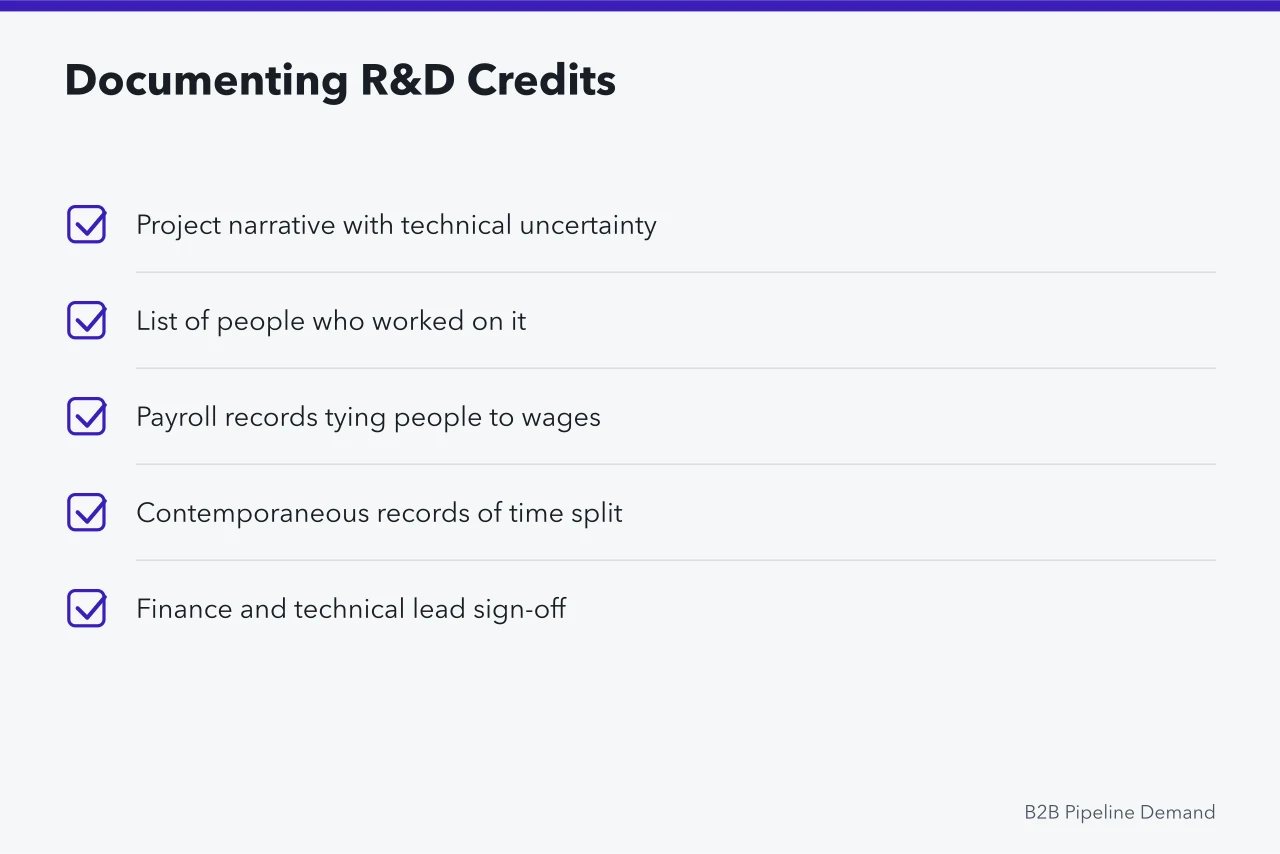
The file should read clearly to someone who was not on the project. A reviewer works from paper, not memory, so each narrative needs a date and a named lead.
- Tie every qualified wage to a named employee and a pay period.
- Write one dated narrative per project, in engineering language.
- Keep time records that separate research hours from support hours.
- Store contract research invoices and the 1099-NEC filed against each one.
- Reconcile the credit schedule to the payroll register before the return goes out.
Run the tax records and audits checklist before the return is filed, not after a notice arrives.
State credits in Massachusetts and Illinois
Massachusetts runs its own research credit with separate rates and caps. It also has programs tied to research institutions and a life sciences credit with its own rules.
Massachusetts sets the credit at 10 percent of qualified research expenses above the base amount, plus 15 percent of basic research payments. The personal income tax version caps the credit at $25,000. Corporate credits carry forward for 15 years.
Illinois ties its credit to the federal definition and adds credits for manufacturers and for employers adding state headcount. Both states treat marketing and sales spend as ineligible.
Illinois sets the credit at 8.5 percent of qualified research expenses above the base amount for tax years beginning on or after January 1, 2024. The credit is not refundable, is limited to tax owed, and carries forward for 5 years.
Named Boston and Chicago examples include Vertex Pharmaceuticals in Boston, Moderna in Cambridge, AbbVie in North Chicago, and Motorola Solutions in Chicago. These are local firms with research operations, not disclosed credit claims.
For a 120-person Chicago firm with $6 million in qualified research expenses and a $4.5 million base amount, the Illinois credit at 8.5 percent is about $127,500. That is an illustrative figure.
State credits are smaller than the federal benefit, but not trivial. Refund and carryforward rules differ, and some credits can be sold or transferred.
Rates and caps change with each legislative session, so a figure from a prior year is a starting point, not a plan. Check the current form before any number goes into a budget.
Selling across state lines widens the footprint again. How sales tax nexus in Texas and Illinois affects pricing shows what an out-of-state customer does to a price list.
Example: mileage and vehicle costs for a Boston research team
Take a Boston firm of about 120 people, half in engineering. Suppose the federal and Massachusetts credits together cut cash tax by $180,000, an illustrative figure.
At the Massachusetts rate of 10 percent, $1.2 million in qualified research expenses above the base amount would produce a $120,000 state credit.
That plan runs on miles as much as money. Driving to a test site, a supplier or a client plant is business mileage.
The IRS set the 2025 business standard rate at 70 cents a mile, up from 67 cents in 2024. IRS Tax Topic 510 compares that rate with the actual expenses method.
A log needs the date, the destination, the miles and the business reason. An app record is enough, and a year-end estimate is not.
Section 179 changes the arithmetic if a heavy vehicle is part of the plan. IRS Publication 946 covers the first-year limits and the rules over 6,000 pounds.
The credit is claimed after the year closes, so the tax deadlines rules for that return decide when the paperwork starts.