Rules
Mileage Deductions for Real Estate Agents in Phoenix and Minneapolis
A season by season mileage log for real estate agents in Phoenix and Minneapolis, with a worked seasonal table, audit ready entries and the 2027 rate question.
What to take away
- Real estate agents usually report business driving on Schedule C, and the mileage log is what an examiner tests.
- Phoenix mileage clusters in the cooler months, while Minneapolis mileage clusters from spring through fall.
- A season tag on every trip makes quarterly estimates and year end totals easy to rebuild.
- The IRS usually announces the next year's standard mileage rate each December, but the rate can change midyear, as it did on July 1, 2026.
- Record odometer readings on January 1 and December 31 for every car you drive for business.
Two climates, one Schedule C
A real estate agent is generally self-employed, so vehicle costs belong on Schedule C. The two ways to claim them are the standard mileage rate and actual expenses. IRS Publication 463 compares the actual car expenses method and the standard mileage rate, including when each can be used.
On the return, the figure goes on Schedule C, line 9, car and truck expenses, where you can deduct the actual expenses of operating the car or take the standard mileage rate. If you claim the standard mileage rate and are not required to file Form 4562 for any other reason, you also complete Schedule C, Part IV, with the information on the vehicle; if you claim depreciation on the car, that information goes on Form 4562, Part V instead. An agent who drives two cars attaches a statement with the Part IV information for the second one.
Seasonal mileage swings in Phoenix and Minneapolis reshape the yearly total more than any single trip. A Phoenix agent drives to new subdivisions in Buckeye, Queen Creek and Goodyear, where listings sit far apart. A Minneapolis agent covers tighter suburbs such as Edina, Bloomington and Maple Grove but loses working days to snow and ice.
Seasonal Mileage: Phoenix vs Minneapolis
Phoenix
- Winter
- Valley-wide showings
- Spring
- Steady pre-heat showings
- Summer
- Early morning drives
- Fall
- Builds to winter
Minneapolis
- Winter
- Thin, remote tours
- Spring
- Peak, weekend open houses
- Summer
- Long daylight evenings
- Fall
- Last push pre-holidays
Compare the seasonal pattern
Phoenix
- Winter
- Winter visitors arrive and showings spread across the valley
- Spring
- Steady showings before the heat builds
- Summer
- Heat and monsoon storms push drives to early morning
- Fall
- Activity builds toward the winter season
Minneapolis
- Winter
- Showings thin out and remote tours take over
- Spring
- Peak season, with open houses most weekends
- Summer
- Long daylight keeps evening showings common
- Fall
- Last strong push before the holidays
Log note
- Winter
- Note lockbox and inspection trips
- Spring
- Full addresses and purpose for every trip
- Summer
- Record the time of day
- Fall
- Monthly odometer readings
Home office, commuting and the trips in between
A home office claimed as your principal place of business generally turns the first drive of the day into business mileage. Without that office, travel from home to a regular workplace counts as commuting. IRS Tax Topic 510 covers car expenses, including standard mileage versus actual expenses, so check it before you call a trip deductible.
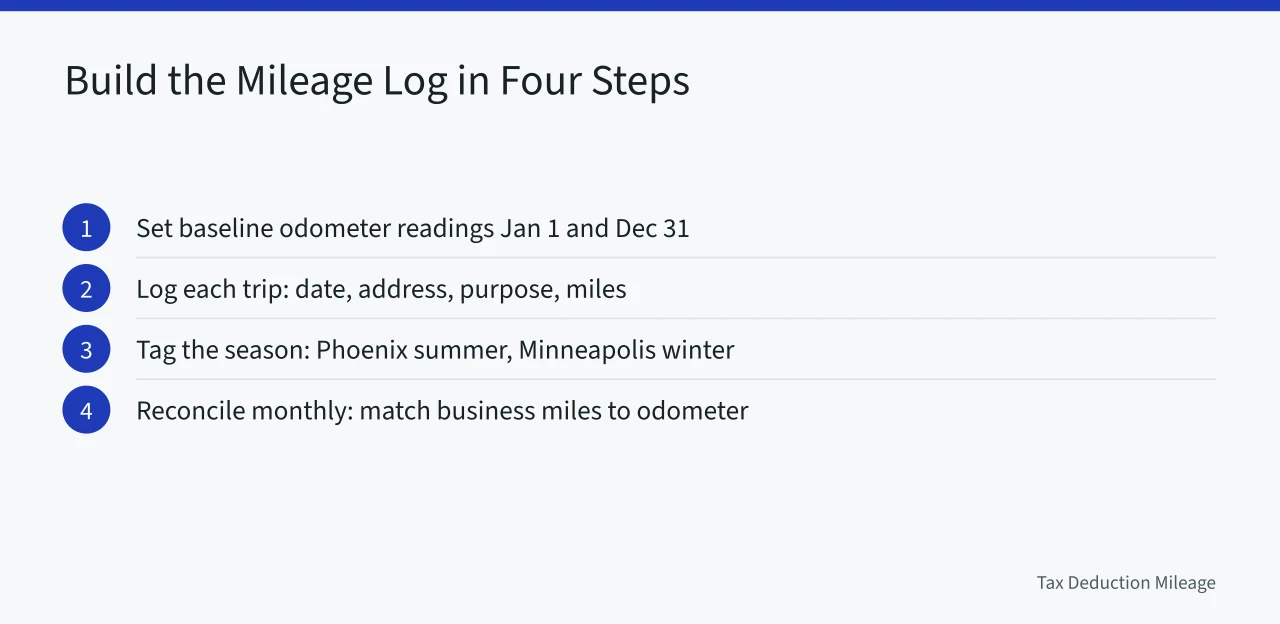
Build the log in four steps
- Set the baseline. Write down the odometer reading for each car on January 1 and again on December 31.
- Log each trip as it happens. Capture the date, the destination address, the business purpose and the miles.
- Tag the season. A label such as "Phoenix summer" or "Minneapolis winter" lets you compare quarters later without rebuilding the year.
- Reconcile each month. Match logged business miles against total odometer miles, then write one line about any gap.
Example: one agent, two seasons
In Phoenix, an agent logs three short January trips to meet winter visitors, then long April drives before the heat arrives. In Minneapolis, the same agent logs almost nothing during a January deep freeze and a heavy stretch in May.
A short note answers the question months later. "Buyer tour, three listings near Camelback Road" takes ten seconds to type.
Each entry follows the same shape no matter the city: date, place, purpose, miles logged.
The date on each entry also settles the rate. Under the IRS's standard mileage rates for self-employed and business use, miles driven from January 1 to June 30, 2026, are deducted at 72.5 cents a mile and miles from July 1 to December 31, 2026, at 76 cents; for 2025 the rate was 70 cents. The IRS lists news release IR-2025-128 as the source of the first 2026 rate and IR-2026-29 as the source of the second. The Minneapolis agent's heavy May stretch falls under the first 2026 rate, while a Phoenix agent's fall drives toward the winter season fall under the second, so the log has to be totalled separately for each half of 2026.
What an Audit-Ready Entry Contains
- Date and day of the week
- Destination address, not just 'showing'
- Business purposebuyer tour or inspection
- Miles driven for the trip
- Client, listing or transaction linked
What an audit-ready entry contains
- Date and day of the week
- Destination address, not just the word showing
- Business purpose, such as a buyer tour or an inspection
- Miles driven for the trip
- Client, listing or transaction linked to the trip
Agents licensed in more than one state
A license can cover more than one state, and each state runs its own revenue system. State business tax is dozens of separate systems, not one, so a second license means a second set of filing habits.
For the two cities here, the federal mileage deduction carries into the state return. In Arizona, the Arizona Department of Revenue taxes residents on "Arizona gross income", which Arizona Revised Statutes section 43-1001 defines as the individual's federal adjusted gross income for the year. In Minnesota, the Minnesota Department of Revenue starts from "net income", which Minnesota Statutes section 290.01 defines for an individual as federal adjusted gross income with the state's own modifications. A Schedule C mileage deduction that lowers federal adjusted gross income therefore lowers the starting figure in both states, and a weak log is exposed twice. The same habit of separating client trips from commutes is how consultants in Chicago track mileage under Illinois rules.
Estimated taxes and the 2027 rate
Real estate income moves with the seasons, so quarterly estimates often need a midyear adjustment. A larger mileage deduction lowers net profit and can lower the required payment. IRS Publication 505 details safe harbor rules for estimated taxes, including paying 90% of current year tax or 100% of prior year tax.
The standard mileage rate for 2027 will arrive in a Notice, typically in December 2026. Do not carry last year's figure into next year's budget without checking that Notice.
Method choice also locks in. Use the standard mileage rate in the first year you drive a car and you can generally switch to actual expenses later. The reverse is not always true.