
Rules
Business Gifts, Awards, Noncash Payments and Borrowed Property: How the IRS Treats Them
How the IRS treats noncash business payments, client gifts, employee awards and borrowed property, plus deduction limits and records for US contractors.
What to take away
- Anything of value received for appearing or promoting is income at fair market value, cash or not.
- The payer usually reports that value on Form 1099-NEC, and you report it either way.
- Low-value pins and keychains are usually ignored as de minimis.
- Borrowed property is not income when it goes back with no fee. Keeping it is.
- Appraisals, loan agreements and mileage logs decide the outcome.
In-kind payment is still payment
A business that hands over a product, a hotel night or a spa certificate for attendance or promotion is paying for a service.
Publication 525, the IRS guide to taxable income, treats the fair market value of that property as compensation to whoever receives it.
That is why a swag bag shows up on a return even when the recipient never deposited a dollar.
A company that gives property worth $600 or more to an unincorporated contractor files Form 1099-NEC with the value in the compensation box.
No form, no change in the rule. The recipient still reports the value, and 1099 tax basics for American creators walks through who files what.
A keychain, a lapel pin or a logo pen costs the giver almost nothing and has no resale market, so it is de minimis.
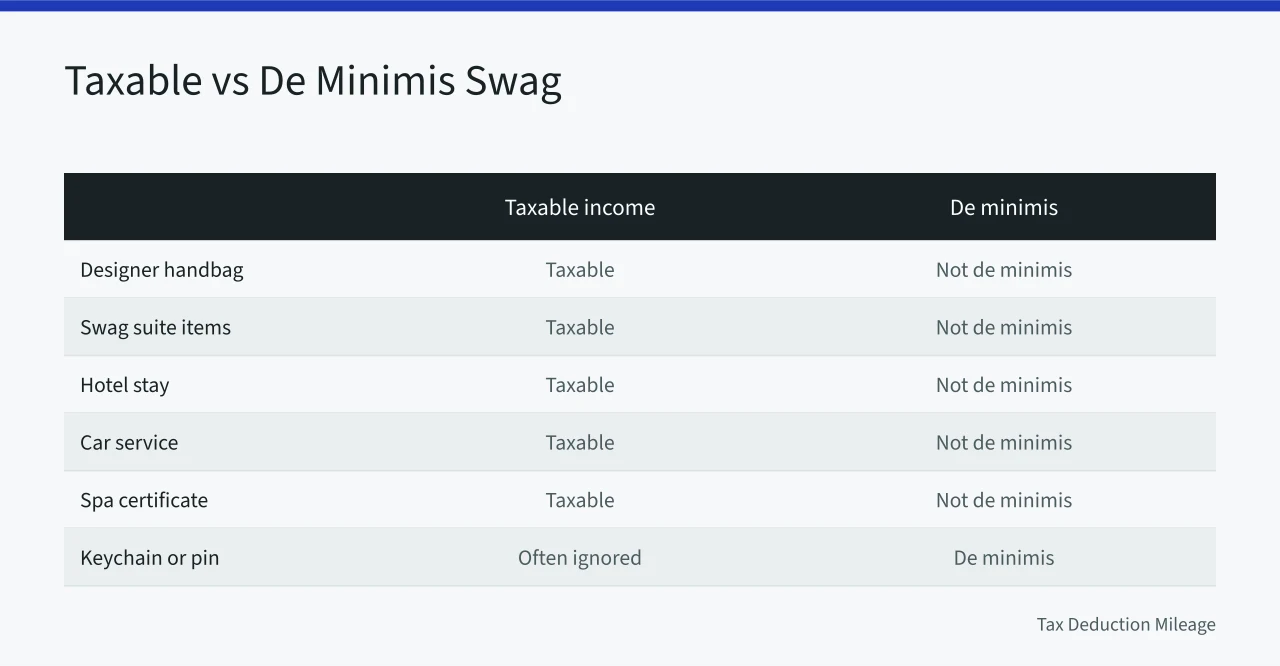
A designer bag, a laptop or a watch is not de minimis. Value and marketability decide, not the packaging.
Business gifts, awards and where the deduction stops
Business gifts to one recipient are limited to $25 per year under IRC Section 274(b), and that cap has not moved in decades.
Engraving, wrapping and shipping sit outside it. The gift itself sits inside.
Employee achievement awards have their own ceiling. The deduction is $400 per employee outside a qualified plan and up to $1,600 under one, per IRC Section 274(j).
Business gifts, awards
| Arrangement | Who reports the value | Deduction limit |
|---|---|---|
| Gift to a client | Recipient, when it pays for work | $25 per recipient per year |
| Product for a campaign | Recipient, at fair market value | Ordinary business expense |
| Employee award | Employee, above the cap | $400 or $1,600 per employee |
Gift stock or samples stored at home raise a separate question, and the home office storage rules cover when that space qualifies.
Borrowed property: loan or compensation
A one-night loan of a necklace worth a fortune is not the same as receiving the necklace. Nothing is income when the piece goes back with no fee attached.
The answer flips when the borrower pays for the privilege, must buy something, or keeps the item. Then the benefit is compensation.
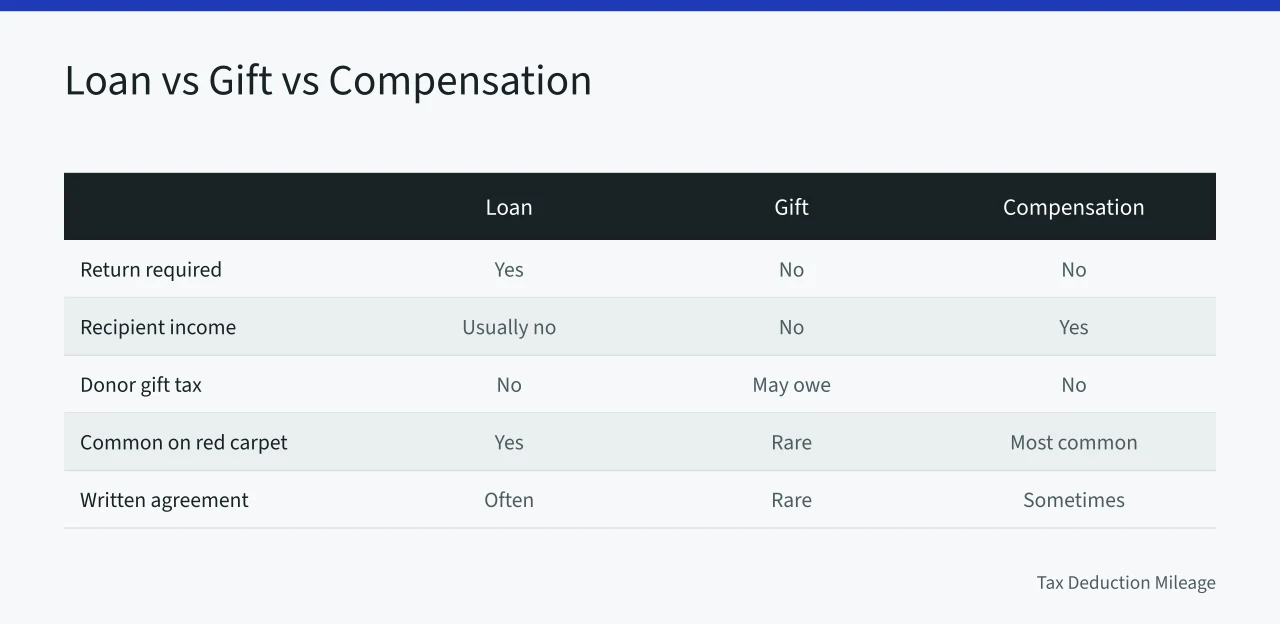
If the recipient keeps the item, the full fair market value becomes income. Basis starts at the amount already taxed, so a later sale stands on its own.
An independent appraisal should state its purpose, its date, and how the number was reached.
Driving to collect, deliver or return borrowed goods is business mileage. Log the date, the destination and the purpose, then use the standard rate published for the year.
The IRS compares that rate with actual costs for the same trips in its car expenses guidance.
Commute trips are the most frequent error in those logs, as mileage rate mistakes explains.
What you can deduct, and what you cannot
Ordinary and necessary business costs are deductible. Fees paid to a manager, a publicist or a stylist qualify when they attach to your trade or business.
Clothing is where most claims fail. An item is deductible only if it is unsuitable for general wear and useless off the job.
Bought rather than borrowed, an item enters the return through depreciation or a Section 179 election.
Records that tie a cost to the work decide the claim:
- Signed loan agreements and return receipts for borrowed items
- Independent appraisals dated within the tax year
- Form 1099-NEC copies matched against your own income log
- A mileage log for pickup, delivery and return trips
Keep the folder by tax year, because the substantiation burden sits with the filer and not the client.
Contractors who want the full calendar, including quarterly dates and the records behind them, can follow the IRS tax checklist for US contractors.
Example: a $9,000 in-kind placement
A $9,000 in-kind placement
- A brand pays a contractor $9,000 in cash and $3,000 in goods for one campaign.
- Gross income is $12,000, and the payer reports the whole amount on Form 1099-NEC.
- Direct costs of $2,500 for shipping and travel are ordinary business expenses on Schedule C.
- Net profit before mileage is $9,500, and self-employment tax applies to that figure.
- Trips logged for pickup and returns add a deduction at the standard rate for the year.
Nothing was withheld from the $3,000 in goods, so that tax arrives with the quarterly bill. Form 1040-ES sets out the safe harbor that keeps the underpayment penalty away.
Set aside the tax when the goods arrive, since the cash to cover it may be spent on the campaign by then.
Records for goods and miles answer different questions, and 1099-NEC and Schedule K-1 mileage rules shows how they line up on one return.