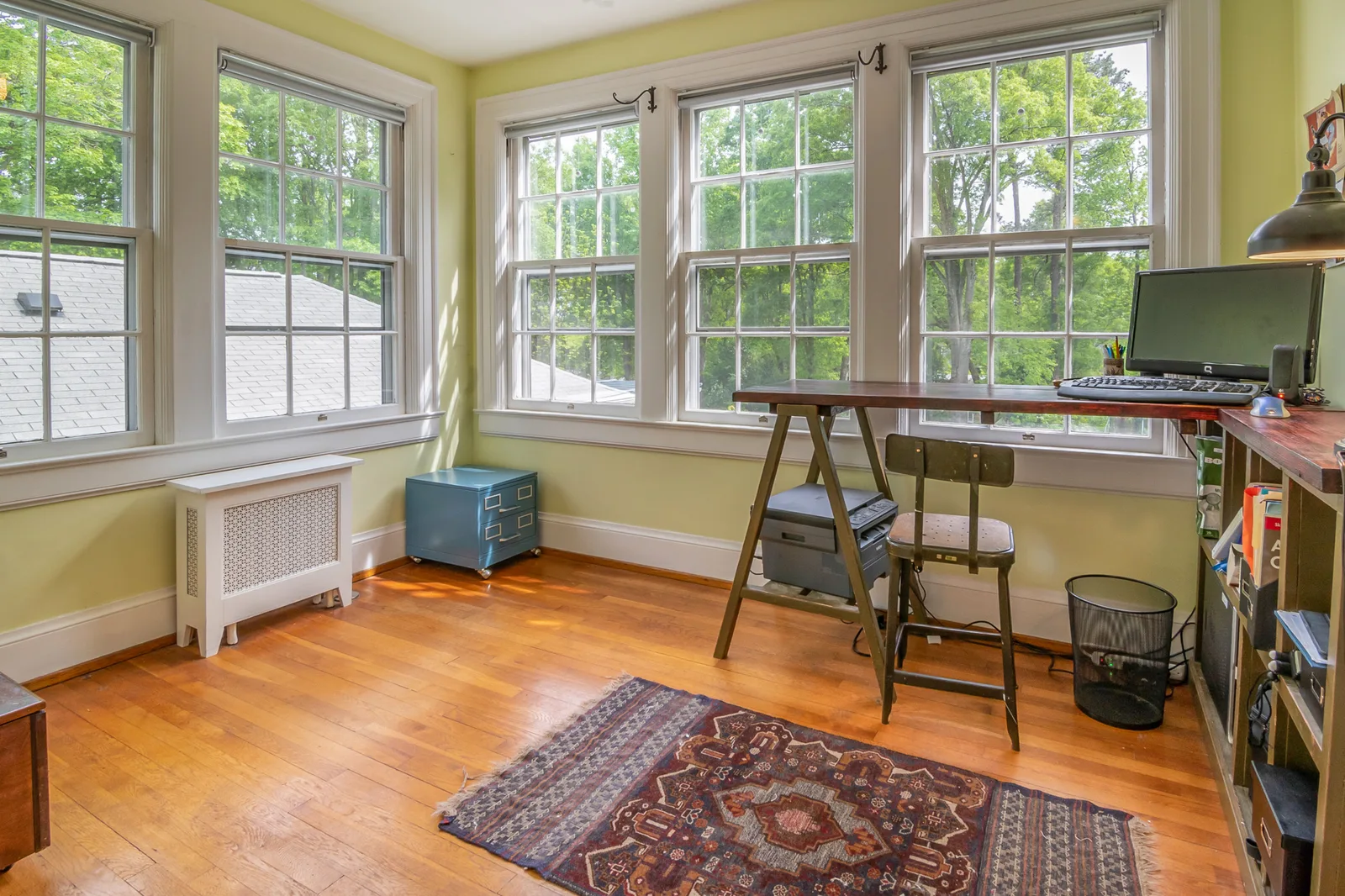
Rules
Tax treatment of US home office storage under IRS rules
Home office storage tax deduction rules under IRS Publication 587: built-in shelving, exclusive-use tests, Form 8829, depreciation and records.
What to take away
- Storage qualifies for the home office deduction when it serves a space used exclusively and regularly for business, or under the separate IRS exception for storing inventory or product samples.
- Built-in shelving that serves only the office is a direct cost. If it is a permanent improvement, its cost is added to basis and depreciated, not deducted in the year paid.
- Freestanding cabinets, shelving and filing cabinets are seven-year MACRS property. Structural storage joins the home's basis.
- The deduction cannot exceed gross income from the business. Form 8829 carries any excess forward.
- Invoices, a dimensioned floor plan and an exclusive-use statement are the records that hold up.
Where the exclusive-use test lands on storage
Storage can be deducted only as part of a space that passes the exclusive and regular use tests. The test looks at the area the storage serves, not the shelf. A filing cabinet in a room used only for consulting passes. A closet organizer in a room that also holds coats fails.
Inventory storage has its own rule. Under IRS Publication 587, if you use part of your home for storage of inventory or product samples, you can deduct expenses for that space without meeting the exclusive use test. All of these must hold: you sell products at wholesale or retail as your trade or business, you keep the inventory or samples at home for use in that business, your home is the only fixed location of the business, you use the storage space on a regular basis, and the space is a separately identifiable space suitable for storage. The publication's own example is a retailer who regularly uses half of a basement for storage of inventory and product samples and sometimes uses the area for personal purposes.
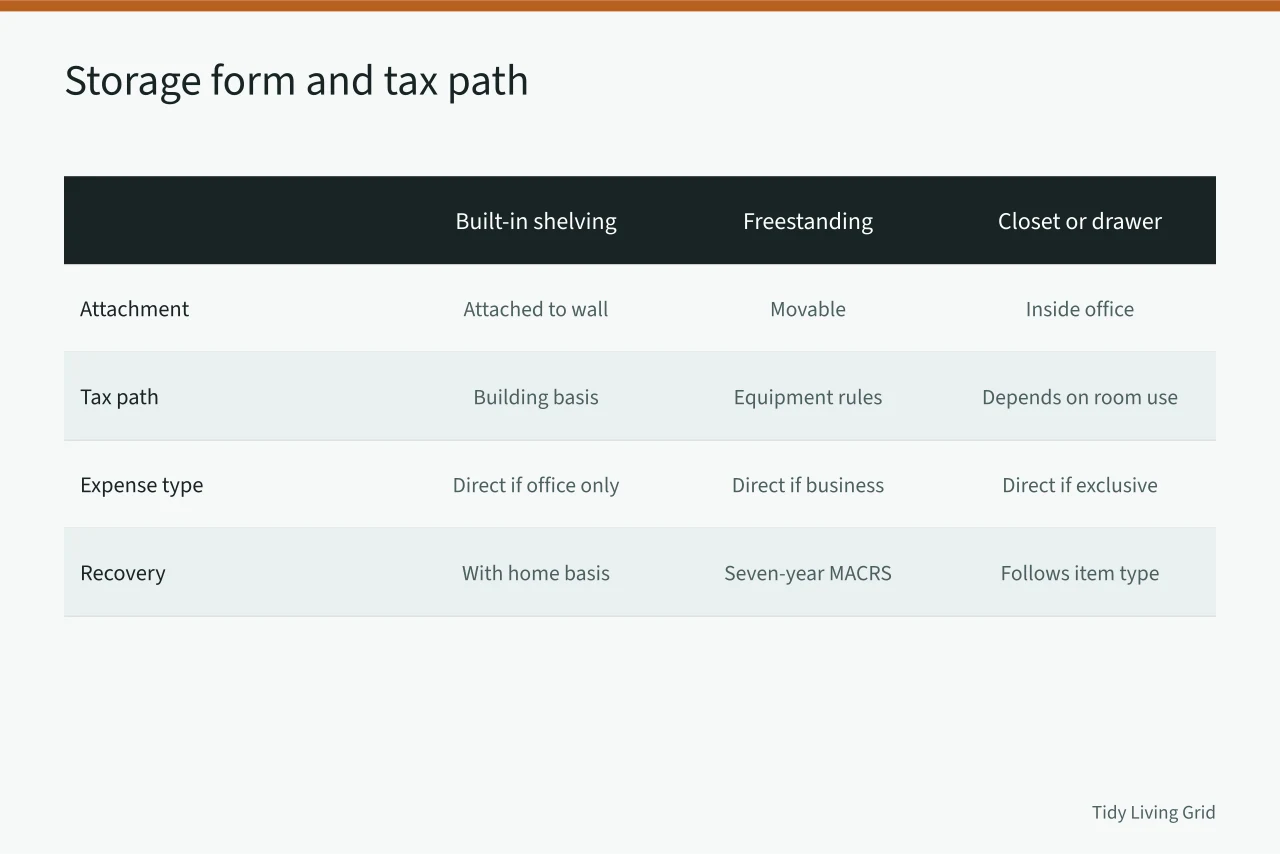
Two questions decide the treatment. Is the item attached to the building, and does it serve only the business area? Attachment drives depreciation; the service area drives the percentage.
IRS Publication 587 sets out both tests and the business percentage method. Topic 509 restates the same requirements.
Direct and indirect storage costs, prorated
Storage in a US home takes three common forms: built-ins attached to the wall, freestanding shelving and cabinets, and closet or drawer space inside the office.
[figure 1]
Direct expenses cover the business area alone, such as painting the office or fitting shelves for that room. Indirect expenses cover the whole house, including rent, utilities, insurance and roof repairs, and get prorated.
The percentage is area based. Measure the office, divide by total finished area, and keep the sketch that produced the number.
| Storage item | Cost type | Treatment |
|---|---|---|
| Built-in shelving on the office wall | Direct | Deduct in the year paid |
| Freestanding bookcase, office use only | Direct or equipment | Deduct, or depreciate over 7 years |
| Whole-home HVAC repair | Indirect | Prorate by business percentage |
| Closet organizer in a shared closet | Mixed | Business share only |
The first row covers shelving that is not a permanent improvement. Publication 587 defines a permanent improvement as one that increases the value of property, adds to its life, or gives it a new or different use, and the cost of a permanent improvement is depreciated rather than deducted. Attached shelving that meets that definition follows the depreciation table in the next section.
Depreciation: seven-year property or part of the home
Movable storage is equipment. Freestanding cabinets, shelving units and filing cabinets usually fall into the seven-year MACRS class.
IRS Publication 946 lists the recovery periods, the conventions, and the limits on expensing property held in a residence. Section 179 and bonus depreciation rarely reach the business part of a home you occupy.
Structural storage follows the building instead. Add the business share of the home's basis to the business share of any improvement, then recover both over 39 years using the mid-month convention.
Publication 587 is direct about the period: if you began using your home for business for the first time in 2025, the business part is depreciated as nonresidential real property under MACRS, on the straight line method over 39 years. The 27.5-year period belongs to residential rental property, not to a home office. A renter does not depreciate the home at all, because only property the taxpayer owns can be depreciated.
Depreciation allowed or allowable is recaptured when the home is sold, even if no deduction was claimed in a given year.
| Item | Classification | Recovery |
|---|---|---|
| Attached built-in shelving | Building improvement | 39 years |
| Freestanding steel shelving | Seven-year property | 7 years |
| Removable closet system in the office | Seven-year property | 7 years |
| Filing cabinet | Seven-year property | 7 years |
Holding title through an entity changes what you can expense rather than depreciate. Which entity tax treatment services are worth paying for compares what each structure changes.
Example: a $4,000 built-in shelving project
- An owner pays $4,000 for built-in shelving in a 150 square foot office.
- The office is 10 percent of a 1,500 square foot home and is used only for business.
- The shelving serves the office alone, so the full $4,000 is a direct cost of the office.
- Built into the wall, it is a permanent improvementthe $4,000 joins the basis of the business part and is depreciated over 39 years. Inside a whole-home project, only the 10 percent business share, $400, would go on the schedule.
- The invoice, floor plan and exclusive-use statement go into the file.
Records and Form 8829 substantiation
The Instructions for Form 8829 require the business percentage, direct and indirect expenses, and the carryover of any blocked amount.
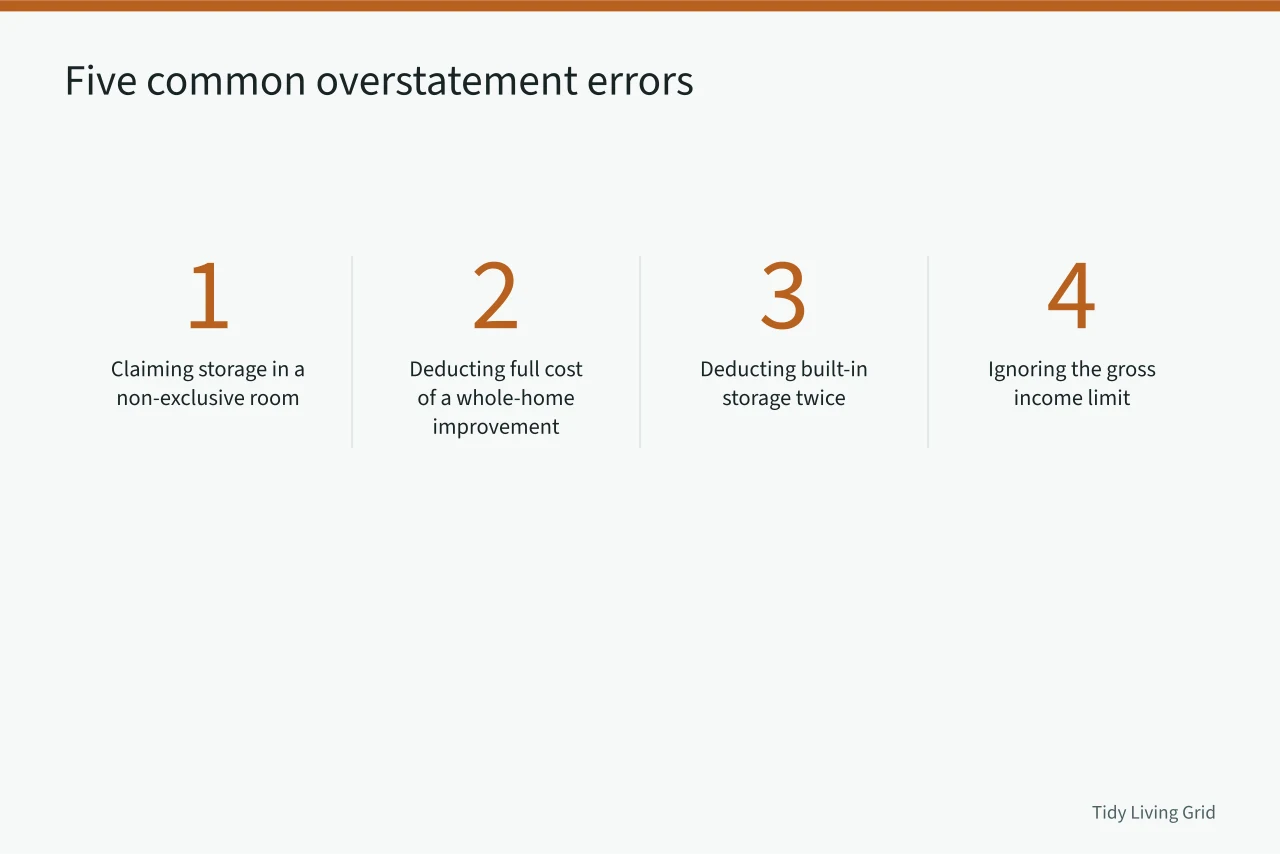
Five errors account for most overstated storage claims: personal items on the shelf, a shared room, an unmeasured percentage, mixed cost types, and no depreciation schedule.
[figure 2]
Checklist before filing:
- The room or area is used only for business.
- The storage holds only business items.
- The business percentage comes from measured dimensions.
- Direct and indirect costs are separated.
- Built-in versus movable storage is identified.
- Recovery period and convention are written down.
Keep the file while the depreciation affects the home's basis, which can outlast the office. A spreadsheet listing item, cost, date, business percentage and recovery period is enough. The same standard applies to vehicle logs, and How IRS Publication 463 defines a business mileage log shows what an adequate record holds.
Photos of the finished installation help, especially for built-in work.