Guides
Mileage and Deductions for US Businesses Driving to Canadian Clients
Business mileage and deductions for US owners who drive to Canadian clients: dated logs, the 2025 IRS rate, parking and meals, and the Form 1116 foreign tax credit.
What to take away
- Keep a dated log for every business drive, written on the day of the trip.
- The IRS set the 2025 business mileage rate at 70 cents a mile in its annual notice.
- Cross-border work does not change the US mileage math on your return.
- Canada's per-kilometre allowance is a Canadian figure for Canadian payers; it does not replace the IRS rate on your US return.
- Tax a Canadian client withholds is usually recovered as a foreign tax credit on Form 1116.
What counts as a business mile
A business mile is a mile driven for a business reason, and the reason has to be written down somewhere. Driving to a client site counts, and so does the airport run before a Toronto flight.
The drive from your kitchen to the spare-room desk does not. Neither does the trip to a coworking desk rented by the month. The mileage rate mistakes that cost sole proprietors the most money start with that commute line.
If your home is your principal place of business, the drive from home to a client is deductible in full. Two stops in one day need splitting. Home to client to home counts, while home to office to client counts for the second leg only.
The record that holds up: date, destination, purpose, miles
The IRS expects a record made at or near the time of the trip, and Publication 463 sets out what that record has to show.
The record that holds up
- Write the date and the opening odometer reading.
- Name the destination and the client or job.
- State the business purpose in one line.
- Record the miles driven.
- File the parking and toll receipts with that entry.
Add the closing odometer reading for each vehicle at year end. Tracking apps fill in the date and the miles from GPS, but they cannot supply the purpose. Weighing what mileage rate services cost against what they capture takes an hour, and the subscription itself is deductible.
Parking, tolls, meals and the 50 percent rule
The standard rate is a package. Fuel, insurance, repairs, tires and depreciation sit inside it, so none of them can be added back on top.
| Expense | How it is claimed | Limit |
|---|---|---|
| Parking at a client site | Separately from the standard rate | Full cost |
| Tolls on a business trip | Separately from the standard rate | Full cost |
| Meals on an overnight trip | Schedule C | 50 percent |
| Hotel on an overnight trip | Schedule C | Actual cost |
| Vehicle depreciation | Actual expense method only | Per Form 4562 |
A fuel receipt proves a purchase, not a business trip, so keep it with the log entry that explains the drive.
Driving on the Canadian side
Canada runs its own vehicle rules. The CRA sets its own per-kilometre allowance, which a Canadian payer uses and which never enters the US mileage math, and the CRA motor vehicle expenses page explains what a sole proprietor can claim in kilometres and how a client allowance is treated.
A client that reimburses travel at the CRA rate is paying you, not covering a cost, so the allowance belongs on the invoice as its own line. If the client pays no allowance, claim the miles on your US return.
Where you do the work still matters. This guide to CRA home-office expenses covers the mirror-image rules if you later split your year across the border.
Example: a Detroit consultant with four Windsor clients
The figures here are illustrative. A consultant in Detroit serves four Windsor clients, and each client visit is a 14-mile round trip. The visits logged over the year add up to 644 business miles, which at 70 cents comes to about $451.
One overnight trip to Toronto adds 460 miles, so $322, plus $90 in tolls and parking and $120 in meals. Meals count at 50 percent, so $60. The hotel night is claimed separately at its actual cost from the receipt, so it sits outside this total. Without the hotel, the year lands near $923.
Reporting the Canadian income without paying twice
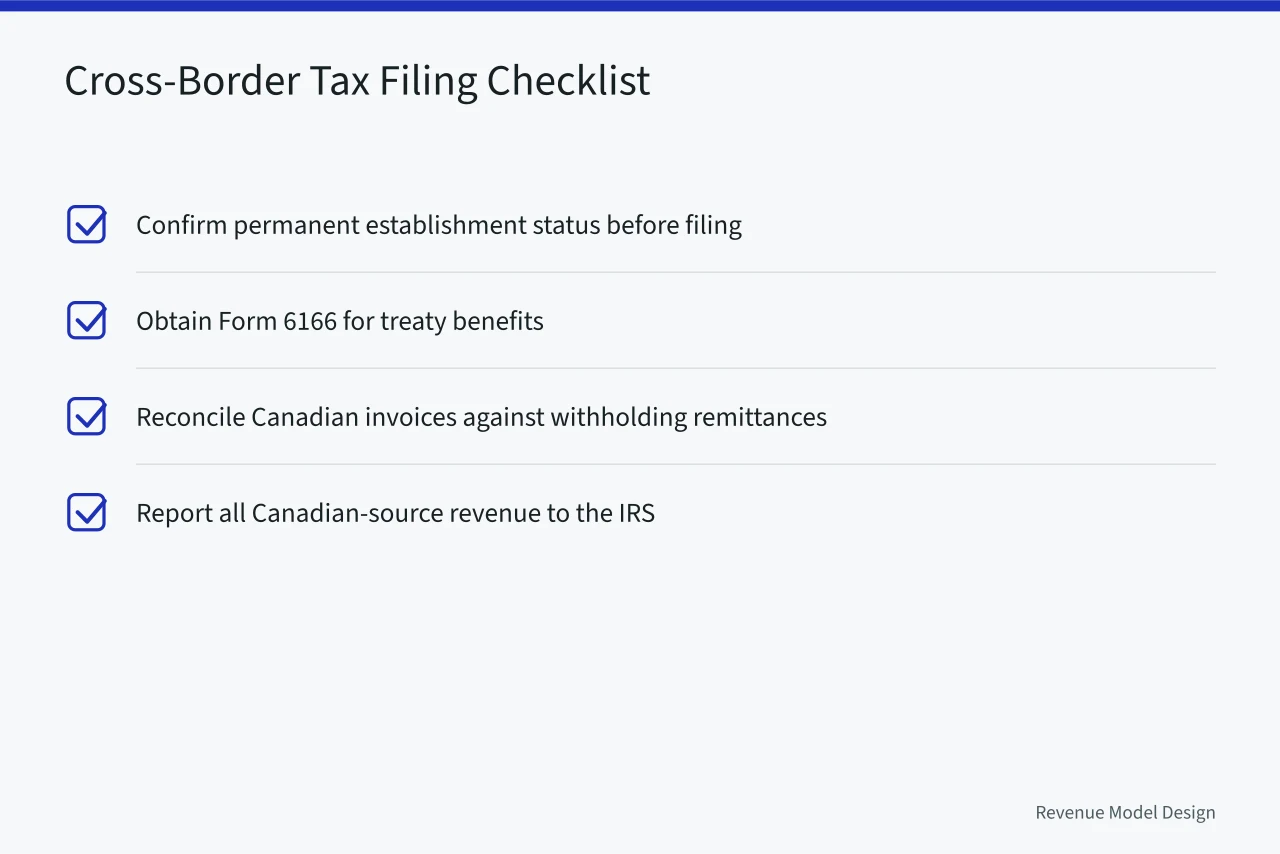
Canadian-source revenue goes on Schedule C like any other income. The miles do not care which side of the border the customer sits on, and the rate does not change with the currency. What changes is the credit. Tax withheld by a Canadian client is claimed on Form 1116, which cuts US tax dollar for dollar.
The withholding itself comes from Canadian law. Regulation 105 of the Income Tax Regulations requires every person paying a non-resident a fee, commission or other amount for services rendered in Canada to withhold tax from the payment. The client then files a T4A-NR information return reporting amounts paid to non-residents for services provided in Canada, and a copy of the T4A-NR slip must also be issued to you. That slip shows the payer, the gross income paid, travel expenses and the tax withheld.
A client in Ontario will not send a Form 1099-NEC, because the form is a US filing requirement. The Form 1099-NEC page lists which payers must issue one.
Keep the T4A-NR slip in a folder of its own. The mileage log explains a deduction, and the slip proves a tax already paid. Neither a 1099-NEC nor a Schedule K-1 changes the mileage deduction itself.